

Location: Florida, USA
Water Body: 7-acre residential pond
Challenge: Chronic algae blooms, oxygen crash, fish kill
Solution: SeDox application
Result: Rapid oxygen recovery, improved clarity, system stabilisation
The Challenge
This 7-acre pond had a long-standing history of planktonic algae blooms, driven by nutrient build-up and internal loading.
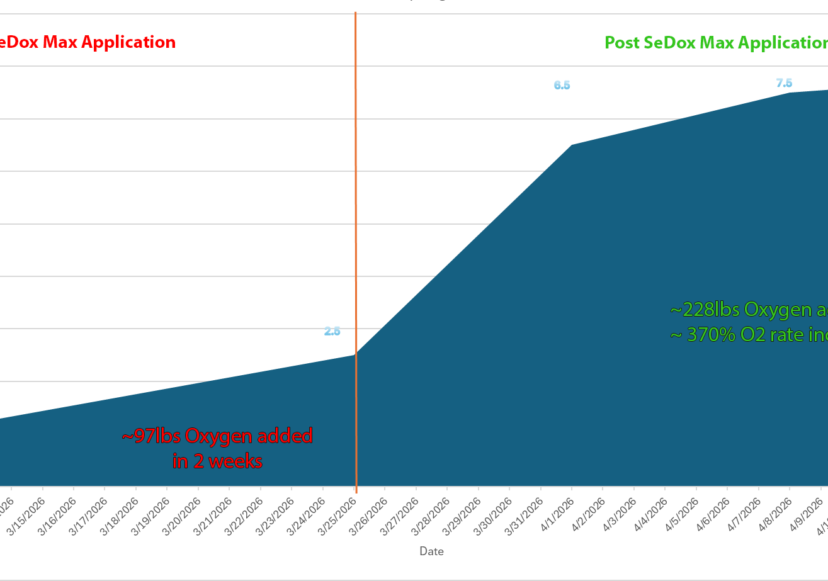
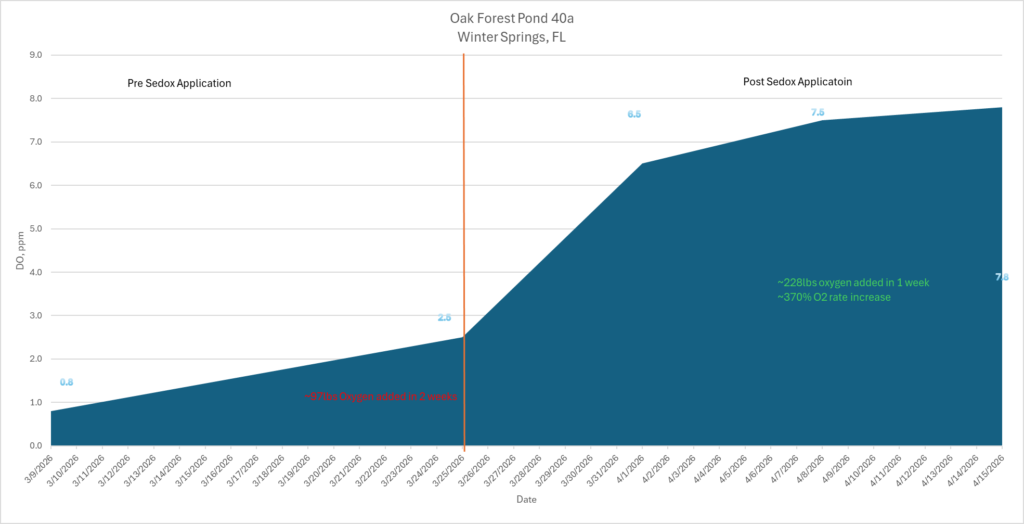
Following an algae treatment in early March, the system destabilised further. Dissolved oxygen (DO) levels dropped below 1 ppm, triggering a fish kill. In the weeks that followed, oxygen levels remained critically low at 2 to 3 ppm, indicating sustained biological oxygen demand and a system struggling to recover.
At this point, the water body was no longer dealing with a short-term issue. It had become biologically unstable.
The Approach
A SeDox application was introduced as part of a coordinated management effort to restore oxygen levels and rebalance the system.
Rather than targeting algae alone, the approach focused on addressing the underlying conditions driving instability:
- Increasing dissolved oxygen throughout the water column
- Supporting biological processes that reduce organic load
- Interrupting the cycle of recurring oxygen depletion
The application process was straightforward, enabling efficient deployment in the field compared to more complex traditional nutrient management treatments.
The Results
The impact was immediate and measurable.
Within one week of application:
- Dissolved oxygen increased from 2 to 3 ppm to 6 to 7 ppm
- Oxygen levels stabilised across the full water column
- Water clarity improved to over 4 feet
This level of clarity had not previously been observed at the site.
The system moved from prolonged instability to a balanced and recovering condition in a matter of days.
Field Validation
Field observations reinforced the data:
- A severe oxygen crash (<1 ppm) led to a fish kill event
- DO levels remained suppressed for weeks prior to intervention
- A single SeDox application resulted in a rapid and sustained oxygen increase
- Water clarity improved beyond previously recorded levels
- Application was completed efficiently with minimal operational complexity
The speed and scale of improvement demonstrate the impact of addressing oxygen demand and internal loading directly, rather than relying on repeated surface-level treatments.
Why It Matters
This project highlights a common challenge in water management.
Treating algae alone does not resolve the underlying imbalance. Without addressing oxygen demand and internal loading, systems remain vulnerable to repeated decline.
By restoring oxygen and supporting natural biological processes, SeDox enables:
- Rapid recovery from critical events
- Improved water clarity and usability
- A more stable, long-term system
Looking Ahead
With strong initial results and positive community response, the pond is now positioned for sustained water quality improvement.
The focus moves from reactive intervention to proactive, long-term management.
